
Columnist Reminds Us All to Never Forget Atrocities, Horrors of Holocaust
How do we keep memory alive? At that point where memory becomes history?
Late January in Indiana is a time that a friend from Texas refers to as “The Gray Zone.” While not a lot is going on, for the Indiana State House things are in full swing to get the Rotunda ready for a special ceremony. Every year, representatives, judicial officers and executive staff take time out from noon to 1 p.m. for the Holocaust Remembrance Program, annually hosted by the Indiana Civil Rights Commission and the Indianapolis Jewish Community Relations Council.
The 27th of January 1945 was the date of liberation of Auschwitz Concentration Camp in Poland. Since then, the 27th of January is commonly recognized as a day of memory with ceremonies internationally.
My wife and I were present last year in Poland at Auschwitz-Birkenau for the 80th anniversary commemoration ceremony. This year I’ll be present at the Indiana State House. Talk about coming full circle.
Auschwitz is a chilling place. A surivor, Primo Levi, once said of it “God cannot exist, because there is Auschwitz.” To walk the camp is both a somber and sacred experience.
Two things I remember about last year’s commemoration was how remarkably warm it was. Only in the lower 40s and much warmer than the snow-covered teens on the day the Russian military cautiously approached the camp.
Secondly, as the sun went down, something macabre and chilling: for security reasons, stadium lights turned on, flooding the camp in artificial lighting. Truly a chilling site and memory.
In the next few days, our CANDLES group would go onto walk through Auschwitz I and Auschwitz-Birkenau. We walked through gas chambers, torture cells, looked into the cell of St. Maximilian Kolbe, walked the selection area and recited the Kaddish (Hebrew prayer for the dead) outside of the Twins Barracks and Mengele’s Blood Lab.
My most personal memory was a moment my wife allowed me to be alone and walk down Block Road B where many who were chosen for extermination took their last walk. My heart was heavy and I remembered a song in my head. Pearl Jam’s Just Breathe:
“Yes, I understand that every life must end,
As we sit alone, I know someday we must go…”
What of the survivors?
Hoosiers cannot think of the Holocaust without remember one of the survivors of Auschwitz who not only survived but came to the United States. Coming to Indiana, she started a family, a museum, and was the driving force to make Holocaust education mandatory in our schools.
Eva Mozes Kor.
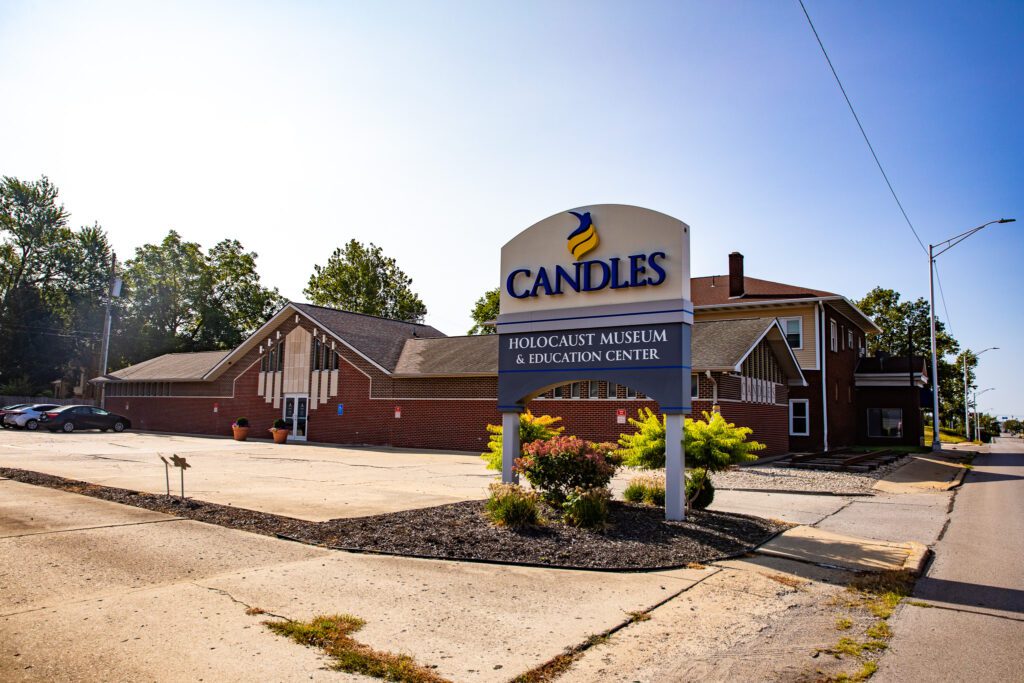
Visitors to Terre Haute, can visit a CANDLES Holocaust Museum, a museum that honors her story of survival, renewal and forgiveness. Virtues in demand today.
CANDLES, short for Children of Auschwitz Nazi Deadly Lab Experiments Survivors, is where I volunteer at. The museum has many artifacts to Eva’s time at Auschwitz, her time in Indiana, and a 3D presentation where visitors can ask Eva questions. Also available are education programs to help equip teachers to teach this critical time in world history.
By the time of this publication: the ceremony will have happened, but there is always work to do to not only honor those who perished, but to ensure the circumstances that made this possible, never happen again.
Never forget.
Photos courtesy Andy Chandler