
Rick Mount, Joe Barry Carroll chose Purdue; Rest is History
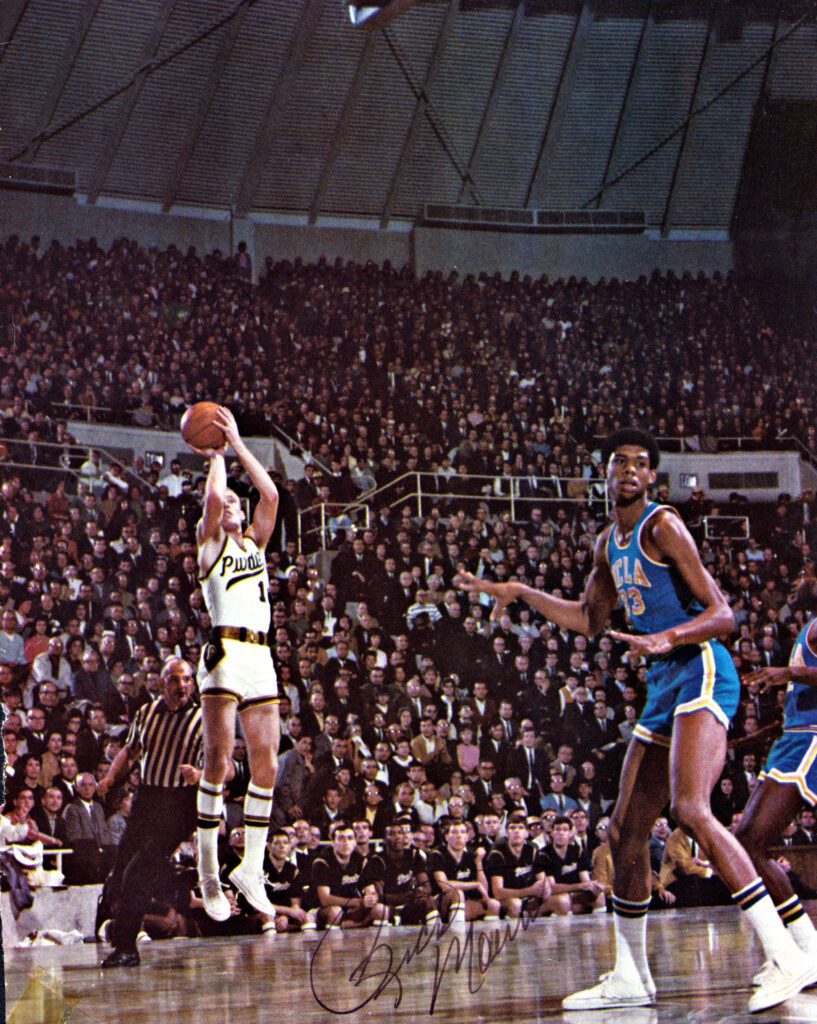
There likely would have been no Big Ten Conference title and a berth in the 1969 NCAA men’s basketball tournament championship game for Purdue if Rick Mount had decided to follow through on his original commitment in the spring of 1966.
That probably would have meant a 39-year gap between conference titles for a program that prides itself on being the winningest Big Ten school. And that’s assuming Lee Rose and Joe Barry Carroll remained in Purdue’s timeline to make the 1979 co-Big Ten title possible.
Miami, Florida was becoming a national program under coach Bruce Hale, who was riding the momentum created by his future son-in-law Rick Barry. The Hurricanes averaged 98 points a game, before the 3-point shot, in 1965 with Barry leading the nation at 37.4 points a game.
So it was no wonder that Miami was appealing to Mount, the greatest college shooter I’ve seen and that includes Stephen Curry.
On May 18, 1966, the headline in the Kokomo Morning Times stated “Miami signs Rick Mount.” Accompanying the story was a photo of Hale and Mount inside Lebanon High School’s library. The caption quoted Hale as saying: “This is the greatest day of my life. Rick is the best I’ve ever seen – and I’ve seen quite a few great players.”
Mount was asked why not Purdue or Indiana. Standing with his hands in his back pockets, Mount said “Well, they have just a little bit more to offer.”
But Mount also offered a throwaway line that ended up being the difference in his recruitment just a few months later: “I made a decision not to attend UCLA about two weeks ago. It’s just too far away.”
UCLA, which was coming off consecutive national championships under Purdue legend John Wooden, is located 1,792 miles from Lebanon. Miami, Florida is 1,052 miles away.
Hale understood Mount’s decision wasn’t a popular one in town. “I’ve noticed there aren’t too many happy people here today. But I think people should be happy with Rick’s decision. This seems more like a morgue than a library.”
But Purdue didn’t give up hope. Head coach George King had three key advantages.
The first was alluded to in the newspaper story. Mount likely felt pressure from the citizens of Lebanon, who wanted to drive a short distance to see one of their own play college basketball. It also didn’t hurt that the mayor was an uncle of Purdue assistant coach Bob King. Nor the fact that Mount’s future wife, Donna, was his high school sweetheart.
“There was no way that Rick was ever going to leave the state of Indiana to play basketball,” Bob King told GoldandBlack.com publisher Alan Karpick in 2011. “The people of Lebanon wouldn’t stand for it.”
But most importantly, under NCAA rules at the time there was no national letter of intent. The only binding document was a conference letter. Mount signed a Big Ten letter of intent with Purdue in late May, cutting off Indiana’s pursuit. That signature allowed Purdue to contact Mount as frequently as George King and his staff desired.
Mount told The Associated Press on May 27 that he signed the conference letter of intent with Purdue “to protect myself in case I should decide to play Big Ten ball.
“But it would be a pretty long shot that I would go to Purdue.”
That long shot cashed in on Aug. 4, when Mount announced he would stay close to home. The Indianapolis Star report stated that Mount changed his mind after competing against several former Big Ten players in summer outdoor tournaments and still scored 30 to 40 points a game without “undue trouble.”
The rest of the story everyone knows. Mount would leave Purdue as an All-American and held the school’s career scoring record of 2,323 points for 54 years.
Purdue discovers Joe Barry Carroll
It was late in Fred Schaus’ tenure as head coach in 1976, and the Boilermakers needed a big man to eventually replace Tom Scheffler.
An introspective 7-foot center named Joe Barry Carroll was beginning to make a name for himself at Denver East High School. But Purdue assistants Roger Blalock and George weren’t in Denver to see Carroll.
In his autobiography “Growing Up in Words and Images,” Carroll tells the story.
“They would never admit it publicly, but Lavon Williams, who was the higher valued recruiting choice of theirs, was not really interested in Purdue. So while they were in town recruiting him, they approached me. Lavon was truly a star basketball player and worthy of all the attention he received that year. He was the LeBron James of my time. Being their second choice meant nothing to me; what mattered to me was I had been offered a world-class education by a world-class institution.”
Carroll arrived in West Lafayette with a cheap Woolworth’s trunk, a few belongings “and a whole lot of ambition in my heart.”
His shot blocking skills quickly made Carroll a fan favorite, with some clamoring for Carroll to replace Scheffler in the starting lineup.
When Carroll did win the starting center job as a sophomore in 1977, he quickly served notice that he was an All-American in the making. In an 80-78 victory at Arizona on Dec. 10, 1977, Carroll posted the only triple-double in Purdue men’s basketball history. His 16 points, 16 rebounds and a single-game record 11 blocked shots led a reporter to call the performance “one of the greatest individual games ever against the Wildcats.”
“Failure was not an option,” Carroll wrote. “At a minimum, I was going to have to graduate with a diploma, and though I could not see much beyond that, it was clear I had to move forward because there was no place to retreat. It never occurred to me that if things did not work at Purdue, I could return to my mother’s home at 2449 Vine Street. That didn’t happen in my mother’s house … There was room for only one adult in my mother’s house.”
Carroll received his diploma in economics just after leading Purdue to the Final Four in 1980. His career totals included 2,175 points, 1,148 rebounds and 349 blocked shots.
Carroll was the No. 1 overall pick in the 1980 NBA Draft by Golden State, which traded Robert Parish and a draft pick that became Kevin McHale to the Boston Celtics. That trade for two future Hall of Famers did not help Carroll’s popularity throughout his NBA career, as if he was the person who orchestrated that swap.
As for Lavon Williams? He played collegiately at Kentucky and was drafted in 1980 too – 100 picks after Carroll in the fifth round by the Cleveland Cavaliers. Williams never played a regular season NBA game.
Next time: What if Matt Painter had signed with his childhood favorite team, Indiana?
Kenny Thompson is the former sports editor for the Lafayette Journal & Courier and an award-winning journalist. He has covered Purdue athletics for many years.