
Speech Marks 81st Anniversary of Ernie Pyle’s Death
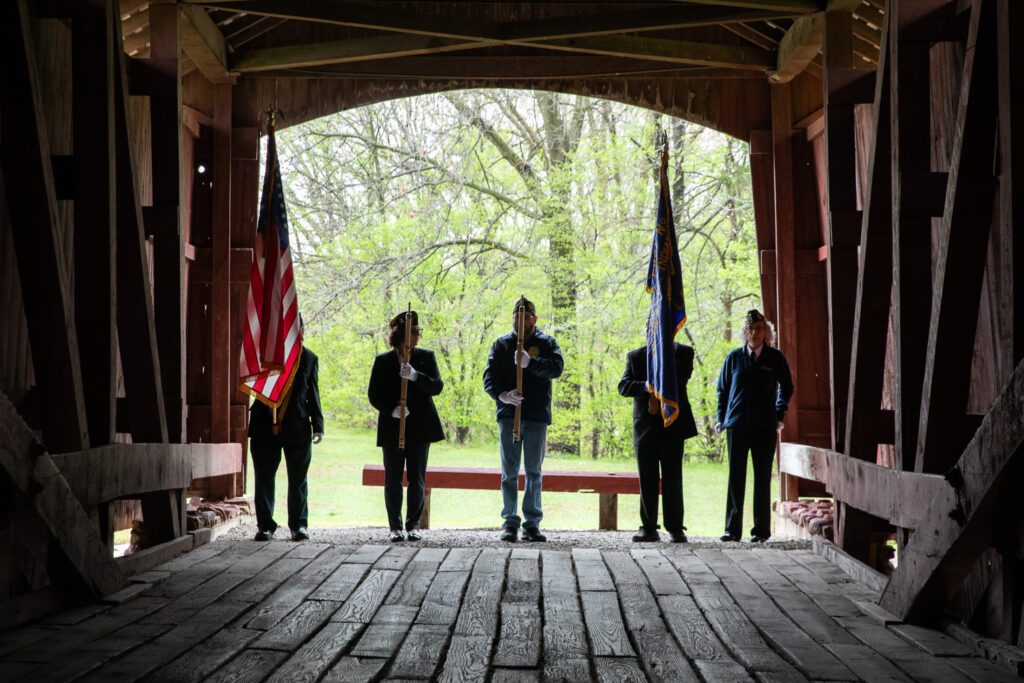
Colors were presented at the ceremony.
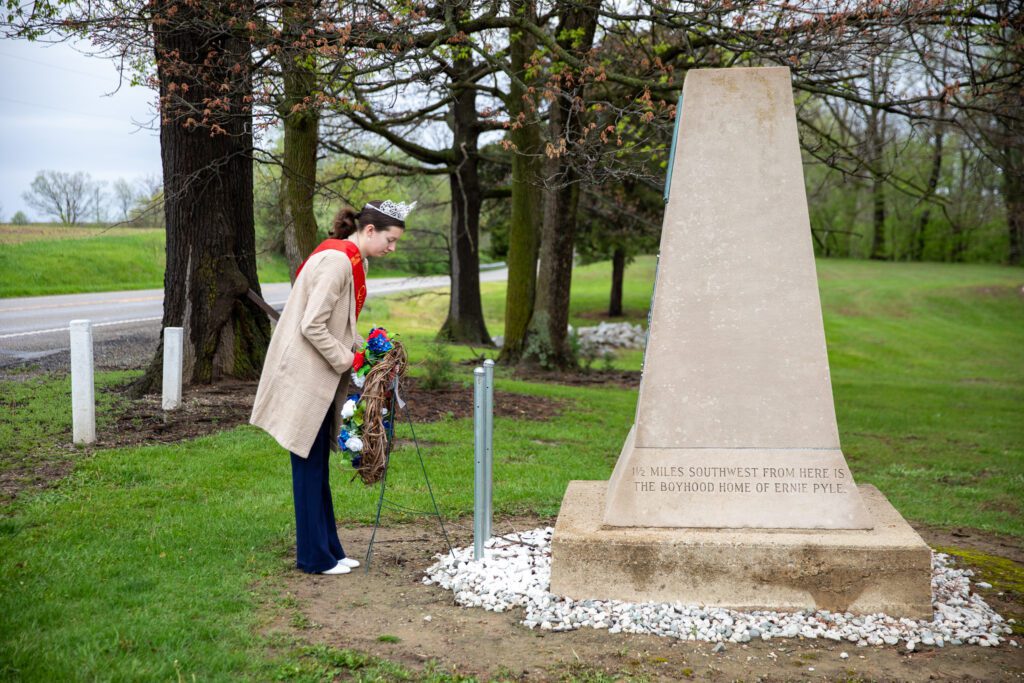
Ernie Pyle Festival Queen Melanie Kashon put a wreath on the monument to Pyle at Ernie Pyle Park in Dana.
Speech Marks 81st Anniversary of Ernie Pyle’s Death
One of the most famous war correspondents in U.S. history was Indiana’s Ernie Pyle. His work during World War II was read by millions and carried in newspapers and magazines across the country. He was killed on April 18, 1945 in battle. On the 81st anniversary of his passing historian, photographer and archivist Andy Chandler was asked to give a speech at the Ernie Pyle WW II Museum in Dana, Ind. Here is the text from that speech.
Friends. It is my privilege and honor to speak to you today on this solemn occasion. Thank you.
When I was asked to give this speech, the original topic was to be about the grandiose memorial and cemetery that was planned immediately after the untimely death of Dana and Helt Township’s favorite son: Ernest Taylor Pyle.
However, in researching this overlooked moment in this township’s history, something began to shine brighter than an overlooked episode: this community.
After Pyle’s death, prominent state officials including Indiana Governor Ralph Gates, attempted to fundraise for a modest library and memorial to Pyle in Dana.
They went to Ernie’s widow and Jerry originally agreed to a statue, library and scholarship from IU in his name. However, forces outside of her and the community grabbed the reins-and what was intended to be a humble tribute, became plans for a 100-acre monstrosity here where we’re standing, complete with two reflection ponds. Ernie’s body was to be repatriated to Dana and placed in a grandiose mausoleum. Surrounded by the graves of unknown soldiers from WWII.
Jerry was incensed. She and Ernie’s father Will put an end to that project. Too ostentatious. Ernie would stay in the Pacific where he lies side by side with the men he reported on.
However, it wasn’t the end for a community wanting to honor its favorite son.
After all, not only did this community give the world one of its greatest reporters but also sparked in him a world view steeped in Midwestern values. It’s a world view that exists today in the faces of people I have met at the museum, and other places like Carters Nest where I get my favorite basket of fries, Off the Tracks cafe and the faces in front of me right now: that of personal humility in the form of self-deprecation, while at the same time, valuing others ahead of oneself.
It is a community where people still put down everything to help others in need.
Pyle spoke of this attitude in a 1937 column describing the aftermath of his mother’s debilitating stroke. The day after the stroke:
“The help began to roll in instantly. The strongest men in the neighborhood came, without being asked, to help lift my mother into her bed. The women came, to help my Aunt Mary with the washing and housework. Others came, and others called to see what they could do . . .
For nearly forty years my mother was the one who went to all these people when they needed help. They haven’t forgotten and now they’re coming to her in droves. Indiana farmers know what a ‘Good neighbor Policy’ is. It’s born in them.”
In the 81 years since his passing, this community rallied around the house he was born in and brought it into town. Before it opened, they donated much of what is seen inside today. When the museum changed ownership a decade and a half ago, the community rallied around it to keep it open as a tribute to Ernie. Recently, they saw the opening of a research area and the unveiling of a statue. This is the beginning of the Ernie Pyle Veterans Memorial Park: and I can assure you, it will be much easier to maintain than the 100-acre park originally proposed.
Yet Ernie, like us, was led to dream, and when during one of his frequent visits after he started working for Scripps, he wrote to his future wife in 1925, that he would lie on the front yard at night, look up at the stars and think of “my Jerry.” Perhaps we too look up at those same stars in this same sky and dream of places we have yet to visit and reminisce or dream of love we have and have yet to experience.
In closing, I want to speak specifically to the students here. I’m reminded of the two report cards of his we have in our collection: his first grade and freshman year report cards. He was an A’s and B’s student. To the young ones still in school: he may have a statue in town and a monument here, but Ernie tied his shoes and went out the door just like you. His parents had to meet the teacher, just like yours do! If you look at Ernie’s report cards, his father had to sign each page of them. He didn’t get them by email.
Perhaps at this very moment, as I look at one of you, I’m also looking at a future Pulitzer Prize recipient. It’s happened here before.